- promedias
promedias – proDT BI UP
- I/O Interfaces
Flush-mounted connection with XLR Output male from Dante, EDIZIOdue
Flush-mounted connection with XLR Input female/Output male to/from Dante, EDIZIOdue
Flush-mounted connection with XLR Input female to Dante, EDIZIOdue
Flush-mounted connection with 2x cinch sockets output from Dante, EDIZIOdue
Flush-mounted connection with 2x cinch sockets input to Dante, EDIZIOdue
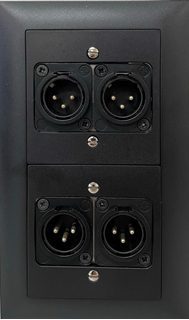
Flush-mounted connection with 4x XLR Input female to Dante, EDIZIOdue
Flush-mounted connection with 3.5mm jack output from Dante, EDIZIOdue
The RME 12Mic-D features twelve microphone and line level inputs with digital, no-compromise, studio-quality conversion; remote controllable gains; integrated MADI and Dante connectivity; plus a multitude of additional functionality, designed for use in high-end studio recording, live audio, and location sound and music recording.
Core 256 is a digital router and monitoring interface with 256 ch. Thunderbolt 3 I/O, 256 ch. Dante AoIP I/O, MADI 64 ch. BNC I/O, 128 ch. 128 ch. MADI SFP I/O module option and 16 ch. ADAT dual TosLink I/O with 256x64 ch. Pro|Mon summing and speaker eq processing.
The Thunder|Core-driven Core 256 does not take up much space, but the power you can squeeze out of this little box is might make your jaw drop to the floor. With tons of channels, a wide palette of digital connectivity, built-in SPQ processing, Eucon control compatibility, internal summing engine and drivers for macOS and Windows 10, it is a pristine digital audio interface by any measure and for just about any application.
AX64 is a Multi-format Audio A/D and D/A converter, router and monitoring interface with 256 ch. Thunderbolt 3 I/O, 256 ch. Dante AoIP I/O, MADI 64 ch. BNC I/O, 128 ch. MADI SFP I/O module option and 16 ch. ADAT dual TosLink I/O with 256x64 ch. and 8 slots for optional multi-format DAD I/O cards. Pro|Mon summing and speaker eq processing.
Dante network Digital audio Adaptor for conversion of 2 Dante signals into 2 line level analogue signals and vice versa.
DX32R is your versatile digital audio Swiss knife - an interface and matrix designed for multiple audio applications such as multi-room recording studios, post-production facilities and audio distribution installations. It allows you to route all digital input and output and manage them on a mono channel basis within a single unit or a combination of units.
With near zero latency, the DX32R can be used to expand I/O channel count and interface digital components, providing a high quality bridge between AES/EBU, MADI and the Dante IP audio network.
DX32R include a 384x384 multiplexer, enabling all digital inputs and outputs to be routed in any combination; this enables the unit to also split signals for advanced signal distribution.
The DX32R IP Audio protocol is based on the robust tried-and-tested Dante™ digital audio network technology, and will interoperate with products of other brands that comply with Dante.
The protocol is compliant with the AES67 standard for AoIP. The Dante and NTP IP Audio formats provide fast, flexible, and economical audio routing via IP and are compatible with the AX32 AD/DA converter, and other Dante devices. The IP Audio routing provides low latency, tightly synchronized, transport of uncompressed audio over Gigabit IP Ethernet Layer 3 networks using off the shelf switches, and routers for audio routing via one or more sub-nets.
A total of 512 channels can be routed on a 1 Gigabit network, and more if the network capacity is higher.
DX32R is TCP/IP controlled via one of the two Ethernet ports vi the DADman Control software available for both Windows and OSX.
The routing of the IP audio via Dante is done by using the Audinate Dante controller software.
The world's first paperless multimedia congress system, developed by TAIDEN as early as in 2010, has ushered in a new era for the conferencing industry and has been used at many high-profile international conferences and meeting venues, testifying in return to its excellence and superiority.
Not stopping there, TAIDEN later launched its third generation paperless multimedia congress system in 2016. The new system boasts of superb HD paperless
experience, greater system reliability, budget-conscious integration of functions and convenient management with its ultra-thin design, larger capacitive touch screen and higher megapixel camera. Either tabletop or flush-mounted model provides its users with faster, more convenient and efficient operation experience. Another innovative and brand-new member — the dual microphone paperless multimedia congress terminal with an extra backup microphone is also added to the growing product line.
Features
• Two Mic/Line Terminal Block Inputs on Rear Panel.
• Converts Mic or Line Audio Signals to 2 Channels Dante Network.
• Switchable Mic/Line/48V Phantom Power for Each Input.
• Terminal Block for Two Audio Outputs on Rear Panel
• Two Audio Signal Outputs from Dante Network.
• Converts 2 Channels Dante Signals to Two Line Terminal Block Outputs.
• Balanced or Unbalanced Signals for Inputs and Outputs.
• Adjustable Gain Control for Output Level on Rear Panel.
• LED indicators for Signal Level and Clip of Each Input Channel on Front Panel.
• Adjustable Gain from -20 dB to +20dB for Each Input Channel on Front Panel.
• LED indicators for Signal Level of Each Output Channel on Front Panel.
• Power over Ethernet (PoE) or 24VDC power supply
• LED Indicators Show the Status of Power and Network.
• High Resolution 24 Bit for DAC and ADC
• Provides High Quality of Preamplifier for Microphones.
• Dimension: 143mm x 45mm x 93mm (WHD)
Blocks are designed for:
connecting analog or digital AES3 audio signals to sound studios and audio mixers using the AES67 or Dante protocol;
transmission of audio signals over Ethernet 100/1000 BaseT;
performing the function of an 8x8 audio switch and creating a distributed network of switches with a common switching field, limited network bandwidth (one audio channel takes about 1 Mbps).
Supports up to 16 channels of balanced analog audio (8 inputs and 8 outputs) or up to 8 channels of AES 3
digital audio (4 inputs and 4 outputs). The type of audio signals (' xxxx ') for inputs and outputs is selected by the user in the device code independently of each other. The first pair of ' xx ' defines the input signals and the second pair of ' xx ' the output signals (' A ' indicates 2 analog stereo signals; ' E ' indicates 2 AES digital signals ). An additional Ethernet port provides connection to a redundant ( Redundant )) audio transmission networks or device cascading. Management and monitoring is carried out over an Ethernet network using a proprietary program Dante Controller . HDB44 audio connectors.
A pair of PBX series devices allows you to implement transmission over a single fiber:
up to 4 x 12 G /3G/HD-SD SDI, ASI signals
AoIP (4 channels of audio, two inputs and two outputs on each side), Dante / AES 67 protocol , Primary / Secondary ports
The Audio to IP Converter ( AoIP ) is designed to connect microphone or line analog audio signals to local Ethernet transmission networks using the Dante protocol or the AES67 standard , for intercom over IP networks and / or for switching audio signals in a network.
An additional Ethernet port provides connection to a secondary ( Secondary ) audio transmission network, and can also be used for cascading devices (Switched).
There are two versions of the device:
models with transport up to 3 G SDI
models with transport up to 12 G SDI ( index -12 G in device code)
To transmit signals over a single fiber, the principle of CWDM (wavelength division) is used in the range of 1470 nm :1570 nm or 1270nm:1410 nm (index ' H ' in the block code). This allows you to organize both one-way and two-way video transmission.
The optical expansion port UPGRADE (1310 nm ) allows the transmission of additional signals transmitted at wavelengths of 1260nm: 1450 nm .
Thus, by connecting through the UPGRADE expansion port the second body ' P roBox ', operating at wavelengths of 1270nm:1410 nm (index ' L' in the block code), it is possible to transmit 8 3G / HD-SD SDI, ASI signals plus implement two independent AoIP lines through one fiber.
Power is supplied from an external adapter 12 V@1000 mA.
The devices are designed for:
- connection of analog or digital audio signals in AES 3 format to the local audio transmission network ( AoIP ) using AES 67, Dante protocol ;
- connection of microphones to the local audio transmission network ( AoIP ) via AES 67, Dante protocol ;
- audio data exchange between Ethernet Dante , AES 67 and 3 G / HD / SD SDI digital video signals (devices with index ' V '); - creation of a distributed network of audio switches with a common switching field; - transfers
Ethernet ( AES 67, Dante ) over optical links;
- indication of audio signal levels ( PEAI -9090, PEAI -9091).
Ethernet Dante audio interfaces , AES 67 support:
- 8 in, 8 out ( PEAI -9088, PEAI -9090) and 16 in, 16 out ( PEAI -9091) balanced analog audio
or 4 in, 4 out ( PEAI -9088, PEAI -9090) and 8 in, 8 out ( PEAI -9091) AES 3 digital audio channels .
Devices with suffix ' V ' contain a 4-channel audio communication module between Ethernet Dante , AES 67 and 3G / HD / SD SDI digital video signals . The devices have an SDI input and two SDI outputs . Up to 16 audio channels of SDI embedded audio are supported .
Devices with suffix ' R ' contain an AES 3 digital audio input/output module with support for User Bits and Channel Bits (compatible with Riedel intercom equipment ).
The PEAI -9090 and PEAI -9091 devices can be equipped with submodules with microphone inputs (suffix ' M ' in code). This provides a voltage supply of '+48 V ' to the microphones and control of the gain of signals from the microphones.
The front panel of the PEAI -9090 and PEAI -9091 has a display that shows indicators for input and output signals.
The type of audio signals for inputs and outputs, independently of each other, is selected by the User (should be reflected in the device code).
The devices have two electrical Ethernet 100/1000 BaseT ports - primary ( Primary ) and backup ( Secondary ) and one optical (except for PEAI -9091). A redundant electrical Ethernet port provides connection to a redundant audio transmission network or device cascading. The presence of an optical transmission line through a separate SFP module allows you to transmit Ethernet ( AES 67, Dante ) over optical communication lines over long distances
( Ethernet SFP module not included in the device; see section 'SFP modules optical and electrical', section II , pos. 1.1:1.6).
Management and monitoring are carried out over the Ethernet network using the proprietary Dante Controller program and via the WEB interface.
Separate power inputs for main and backup power supply. 'Hot' replacement of power supplies.
Audio connectors DB 25 and RJ 45 (on module ' R ').
Press Splitter with Dante input plus analogue audio. Passive distribution and PoE.
Third party applications that use Dante Ready™ allow customers to purchase and activate Dante audio channels after installation using the Dante Activator tool in Dante Controller 4.5 or higher. Dante Activator is tied to an active Audinate user account and accepts standard credit card payments.
Activation instructions: