KLANG:technologies – KLANG:konductor


More details

Similar Products

klotz-graphite-two_600px|klotz-graphite-two_600px
  • Klotz

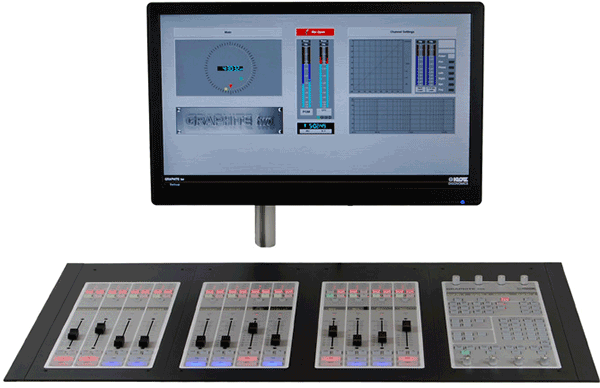
Klotz – GRAPHITE TWO

GRAPHITE TWO consoles are extremely versatile as they can be configured either as stand-alone or as networking consoles.  GRAPHITE TWO consoles are extremely versatile as they can be configured either as stand-alone or as networking consoles. The fully modular design allows configuring mixing consoles from 8 to 32 faders - up to 640 input and 640 output channels. Many features can be programmed individually by the customer such as monitor feeds, GPIs and GPOs, sources and busses and logic commands. The control surfaces are connected by either IPX/SPX or TPC/IP protocol to the G2 audio engines and routers and can share all sources and outputs within the audio network. Using the IPX/SPX protocol interface, GRAPHITE TWO consoles are an ideal option to upgrade existing VADIS* system installations as they are fiully VADIS* compatible. A unique feature is the option to install a break-in / break-out unit within the console frame. The interface unit is fitted with 8 audio input channels which can be configured either as stereo or mono inputs and outputs. The interface unit uses a Dante protocol-based Ethernet connection to the main frame which can be located in the main control room (MCR). GRAPHITE consoles offer a range of features that can be configured via the GRAPHITE configuration tool. Users can define presets for audio settings, function keys for GPIO and other control features, external sources for control room and studio monitoring, and snapshot keys to store the entire console set-ups.
    Personal Mixing & Monitoring
studer-onair-3000_600px|studer-onair-3000_600px
  • Studer

Studer – OnAir 3000

The Studer OnAir 3000 further extends Studer’s range of digital broadcast consoles with a completely new design aimed at the medium to upper segment of the radio market including private and public network broadcast stations. The Studer OnAir 3000 further extends Studer’s range of digital broadcast consoles with a completely new design aimed at the medium to upper segment of the radio market including private and public network broadcast stations. The operating concept of the OnAir 3000 will be totally familiar to Studer users, as the wide range of compact and elegant control surface modules incorporates the same patented “Touch-n-Action” philosophy as the highly successful Studer OnAir 2000, using colour GUI screens. The OnAir 3000 design is based on a completely modular desk and a new DSP engine. The fader module includes six fader strips, and up to eight fader modules may be fitted, giving a maximum console size of 48 faders. Layout options range from a highly comprehensive engineer-operated continuity console to a single fader panel for DJ and newsroom use or even a PC-operated system with no physical desk controls. The console has three main stereo mix buses plus an audition facility, four stereo AUX buses, 16 mix-minus sends configurable as AUXes, and three independent studio monitoring circuits and offers full dynamics, EQ and input/output routing in each channel.
    Personal Mixing & Monitoring
  • Dante Ch: 64x64
  • 48kHz
ASL-ENC-1202_1200px|ASL-ENC-1202_1200px
  • ASL

ASL – Enchorus ENC 1202

The ENCHORUS ENC 1202 Dante™-based audio network module offers eight line outputs with individual delay (at a maximum of 2.7sec.) and four line inputs, with a four-band equalizer on each input and output. The ENC 1202 features eight built-in mixing engines and support for sample frequencies up to 192kHz. The device is easy to control and monitor through a web interface. A built-in audio matrix allows flexible routing of all inputs, outputs, and mixer signals. The ENCHORUS Dante™-based audio network was designed specifically for stage applications, offering professional connectors and superior audio quality. All ENCHORUS models include filtering and mixing capabilities and can be configured very rapidly via the integrated web interface. ENCHORUS modules are tough enough on their own but also include rubber bumpers that allow them to be easily and safely stacked on stage.
  • Throw-down Box
  • 8x line outputs with delay (max. 2.7sec.)
  • 4x line inputs
  • Support of redundant Dante networks or daisy chainable
  • 4-band EQ for each input and output
  • 8x built-in mixing engines (16 inputs, stereo output)
  • Built-in audio matrix for flexible routing of all signals
  • Control via web interface
  • Sample rates: 44.1kHz/48kHz/88.2kHz/96kHz/176,4kHz/192kHz
    Personal Mixing & Monitoring