DConXi


More Details

Similar Products

Eagles-44-Front
  • Tendzone

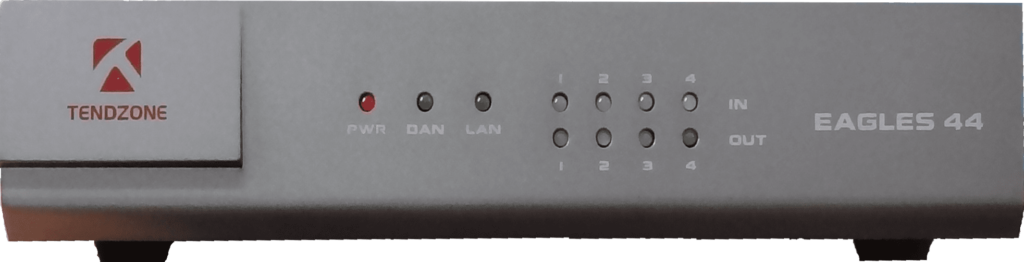
Tendzone – Eagles 44

Eagles series audio interfaces are a Dante compatible networked audio technology device. They provide an economic solution for distributed audio via standard Ethernet switch and CAT5/CAT E6 cabling. They are PoE (power over ethernet) compatible, but can also be powered locally. They are available in 4input x 4output, all inputs/outputs can be set to either mic or line level.

    I/O Interfaces
ru-nl4_400px|ru-nl4_400px
  • RDL

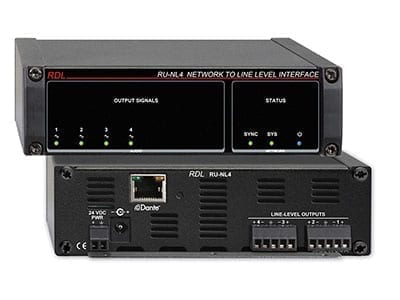
RDL – RU-NL4

The RU-NL4 is a high quality Dante network to line level interface. The RU-NL4 converts four Dante network audio channels to +4 dBu balanced line level that corresponds to a network digital audio level of -18 dBFS. LED audio signal indicators are provided. Model RU- NL4P operates from PoE. The RU-NL4 is a high quality Dante network to line level interface. The RU-NL4 converts four Dante network audio channels to +4 dBu balanced professional line level. The front panel features signal LEDs that indicate audio presence for each of the received network signal channels. Balanced +4 dBu audio levels correspond to a network digital audio level of -18 dBFS. The noise floor is better than 80 dB below operating level. Crosstalk is below the noise floor between all outputs across the entire audio spectrum. The RU-NL4 is also available in a PoE version (RU-NL4P). If PoE power and an external 24 Vdc supply are both feeding an RU-NL4P, the unit will run from the external supply and will seamlessly switch over to PoE power upon loss of the external supply. 
    I/O Interfaces
joseph-electronics-dft-exp_1200px|joseph-electronics-dft-exp_1200px
  • Joseph Electronics

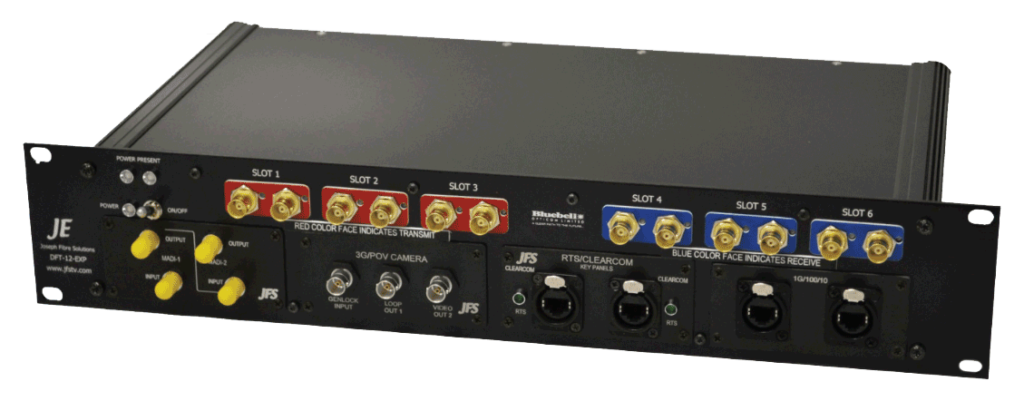
Joseph Electronics – DFT-EXP

The new DFT-EXP Series from Joseph Electronics provides for up to 12 channels of 3G/HD/SDI uncompressed video plus four additional slots that can be fitted with a selection of other convenient modules for audio, intercom, analog video, genlock, MADI, and even Dante. The new DFT-EXP Series from Joseph Electronics provides for up to 12 channels of 3G/HD/SDI uncompressed video plus four additional slots that can be fitted with a selection of other convenient modules for audio, intercom, analog video, genlock, MADI, and even Dante. All of this is transported on one or two singlemode fibers, depends on configuration) and can also be operated with optical redundancy. Housed in a compact 2RU fanless enclosure with redundant power supplies, up to six 2-channel modules can be fitted for signal counts from 4 to 12. The direction of each module is field reconfigurable to take care of last minute changes. Transmit modules are red and receive modules are blue. Red modules (TX) are slot specific and clearly labeled. The Blue modules (RX) are generic and can go in any slot.  Modules support SMPTE 424, SMPTE 292, SMPTE 259, SMPTE 297 and DVB-ASI. Units can be set to operate in non-reclocking mode to handle any signal from 50Mb/s all the way up to 3Gb/s. A Joseph’s exclusive is the Bypass Channel. This innovative feature allows you to add even more analog video, audio, or data. Units can be custom configured with fiber connections on the front or rear of the enclosure. Convenient LEDs indicate signal presence and link status. Trust Joseph Electronics to come up with innovative and flexible fiber transport solutions that allow broadcasters to make those last-minute changes quickly and easily.  The DFT-EXP Series is ideal for anyone who needs to move a variety of signals point-to-point. Whether for announce booths, host positions, stand-up postions, edit suites, or cross-campus feeds, The DFT-EXP takes advantage of the high bandwidth and dramatic weight savings offered by fiber to deliver pristine video signals and clean audio over far greater distances than copper. Custom features such as the placement of the fiber connectors; audio, Ethernet, data, and  intercom connectivity; optical redundancy; 1 or 2 fiber operation; and the By-Pass channel, ensure that customers get exactly wht they need and don’t pay for features that they don’t want or will never use. The ability to reconfigure your signals on-the-go has gone from being a convenience to being an absolute necessity. With nothing more than a basic screwdriver, users can quickly and easily make the last minute changes the inevitably come up on remote broadcasts.
    I/O Interfaces