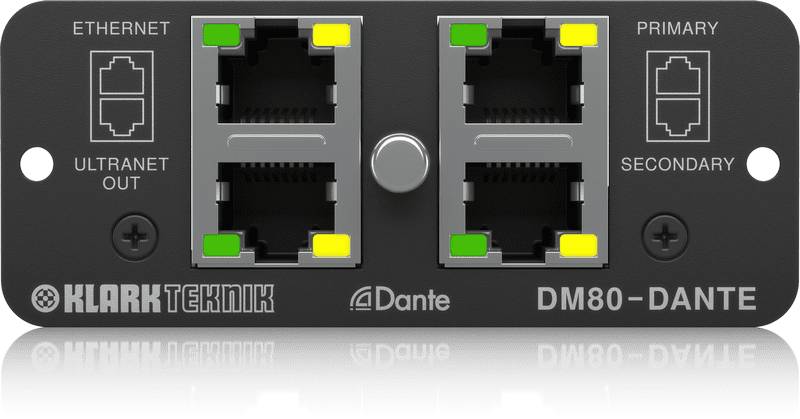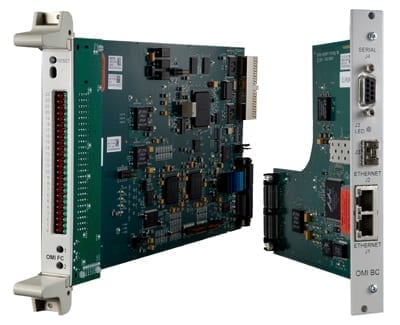

Adam Hall – LD Systems X-EDAI


More details

Similar Products

roland-xi-dante-expansion-interface|roland-xi-dante-expansion-interface
  • Roland

Roland – XI-DANTE Expansion Interface

The Roland XI-DANTE expansion interface card enables the Roland ORCHA series of products such as the M-5000 live mixing console, full-duplex two-way communication on a maximum of 64 channels at 48kHz (32 channels at 96kHz). The card contains primary and secondary ports to allow for redundancy or daisy-chained Dante-enabled devices, and a control port.
    Dante Interface Cards
  • Dante Ch: 64x64
  • 24-bit
ax32-dante-option-card-route1088-v2
  • DAD

DAD – Dante / AES67 Expansion Card

AX32 already support 64 channels of Dante IP Audio via an optional module, but in an effort to meet demand for an even higher channel count, our an optional expansion card adds another 128 channels to your digital audio-routing matrix.

Further, with eight slots available for expansion cards, you could ultimately have up to 1,088 Dante/AES67 channels, including the 64 channels that comes as standard, at 48 kHz.

The Dante expansion card also offers sample rate conversion on all channels as well as dual redundancy network ports in order to maximize reliability, reducing the risk of losing valuable production time.

Independent Sample Rate Conversion

The Dante expansion card features per-card sample rate conversion, which by using more cards allows several independent audio networks that run on individual clocks and sample rates to be connected to and unified in a single AX32 unit.

This naturally unleashes a wealth of possibilities for distributing audio across sources and destinations on highly complex setups that e.g. involve sending a feed to an OB truck, while recording at a different sample rate and sending yet another feed to a FOH console or an in-ear monitoring system.

Simply adding more Dante channels may sound trivial, but once you start to think about the actual problems that this amount of channels in combination with independent sample rate conversion is capable of solving, it’s a quite significant improvement of the overall system.

For instance, the new Dante card will immediately be able to solve real-world challenges in regard to high channel counts when working with Dolby Atmos Mastering Suite, as well as in recording studios where Dante based monitoring systems are used, but there is a need to record at a different sample rate or in Live applications where there Dante networks have to be kept physically separated when operating on different clocks.

The internal sample rate converters on the new Dante cards have been developed in-house and we have never compromised on the quality of our AD/DA converters – or internal sample rate conversion within the digital domain. ‘Digital’ is simply part of our brand name and we take that very seriously!

Applications

- Live & Events

- Film Production (Dolby Atmos Mastering Suite)

- Broadcast

- Music Production

Highlights

- 128 channels @ 48 kHz / 64 channels @ 96 kHz / 32 channels @ 192 kHz

- Independent Sample Rate Conversion

- Dual Redundancy Ethernet Ports

- AES67 Support

- Up to 8 cards in a Single AX32 Mainframe

Details

The Dante card can operate either as a single 128x128 channel interface with a switch for the two Ethernet connectors or redundantly, where the two Ethernet connecters are connected to different networks each carrying 128x128 channels. If more cards are installed, each card can be connected to a different network or more cards can be connected to the same network via an external Ethernet switch or by bridging the network between the cards when operating in non-redundant mode.

The Dante card can operate in Dante mode or AES67 mode with support for discovery via SAP. In Dante mode, Dante Domain Manager (DDM) is supported for enhanced network management functionality. Configuration of the card is managed via DADman.

    Dante Interface Cards
  • Dante Ch: 128x128
  • 24-bit
D-NVC2
  • RDL

D-NVC2

Dante / AES67 Network Volume Control
  • Rotary Encoder Volume Control with Full-Color LCD Display
  • Attenuation Applied to One or Two Dante/AES67 Audio Channels
  • Network Audio Channels are Routed Through the D*-NVC2
  • Knob Rotation Adjusts Audio Volume Up or Down
  • Attenuation Adjustment in 1 dB Steps From 0 to 63 dB then Mute
  • Programmable Knob Action Acceleration
  • Momentary Knob Push to Mute/Unmute with Screen Indication
  • Extended Knob Push to Open Menu
  • Menu Allows User to Adjust Output Channel A, B or Both
  • Option to Sum Stereo Input to Mono on Outputs A and B Using RDL CONSOLE
  • Installer Sets Menu Default and Defines Channel Names Using RDL CONSOLE
  • The D-NVC2 May be Remote Controlled by RDL D-NMC1R or D-NLC1R
  • Selectable Screen Display Color Themes Using RDL CONSOLE
  • Adjusts Levels of Network Audio Signals Routed Through It*
  • Displays Audio Attenuation Level Applied to Routed Signals*
  • PoE Powered
  • Available in Stainless Steel, Black and White
    Dante Interface Cards
  • Dante Ch: 2x2
  • 24-bit