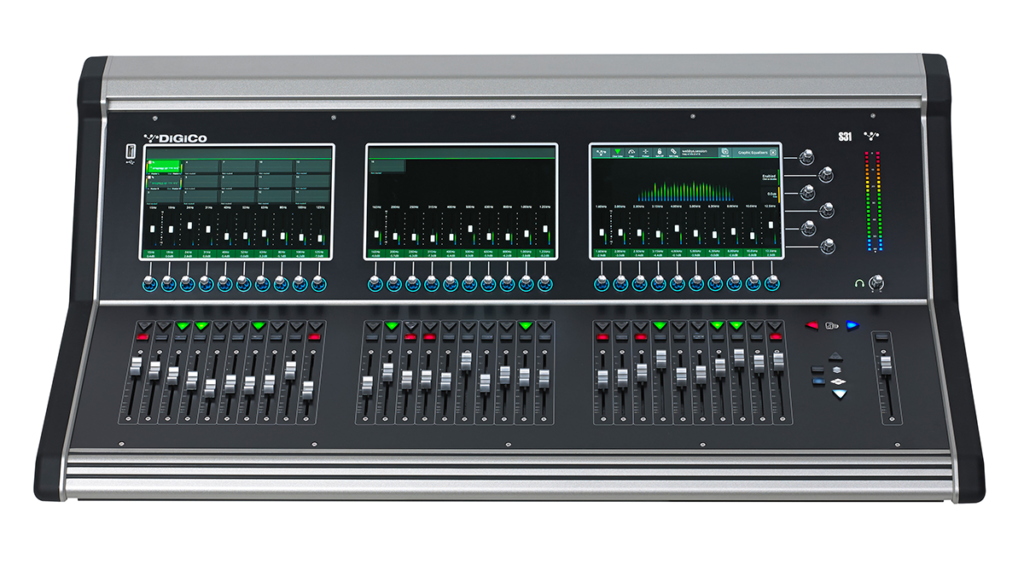
Meet the S31, the latest console in the S Series, which opens even more doors, allows for increased functionality and accessibility, all at an affordable price point. This time around, there are 31 faders, and three 10" multi-touch screens... And it'll still fit in back the of the car!
When the S21 was unveiled to the public, engineers were immediately drawn to it. Never before had a console so compact been capable of this standard of audio quality, power, flexibility, and you could fit in the back of your car!
Its two multi-touch touch screens broke the mould for small format consoles, with 21 faders, and bundles of I/O.
Now, DiGiCo has gone one step further. Meet the S31, the latest console in the S Series, which opens even more doors, allows for increased functionality and accessibility, all at an affordable price point. This time around, there are 31 faders, and three 10" multi-touch screens... And it'll still fit in back the of the car!
Scratching the surface
It's a given that with any DiGiCo product, audio quality is of paramount importance; the SD Series is testament to this, be it the rack mount SD11 or the flagship SD7, audio performance comes first. With the introduction of the S Series, DiGiCo used the same principles, developing a smart concept with the same core FPGA engine algorithms and processing, all running at 96kHz, which means no loss in audio quality or functionality.
The S31 is now the bigger version of the S21. The S31’s expanded work surface offers 10 additional faders for more control and two other multi touch screens for faster access and more visual feedback. Ideally suited to applications where more instant control and feedback are critical to the operator.
We at DiGiCo also know that many engineers like to keep their VCAs separate; this is now easily achieved, without compromising your preferred workflow with the option of dedicating a section to your VCA’s. Naturally these faders are in groups of 10, so there's plenty of space to build a full production: why not layout a whole drum kit on one bank, an entire strings section on the second, and the band on the third? It just makes everything that little bit more accessible.
The S31 still offers the same flexibility as the S21, with 24x Mic inputs and 12x line outputs on the rear of the console, for straightforward audio connection. There are also 2x DMI ports as standard on the console as well as the UB MADI interface for DAW recording. It goes to show that big things do come in small packages.
How to make the step
To date, it has been the Tiger SHARC controlling the FPGA, but integrating these three technologies, along with networking capabilities, was a brand new challenge. Using the high power QuadCore SoC, associated with high bandwidth memory, S31 connects to a low power 484-ball array FPGA which in turn connects to fourth generation control SHARC DSP, capable of not only controlling the FPGA, but offering the potential for additional processing in the future. The compact footprint of the S31 has no relationship to the scale of processing power going on under the polycarbonate worksurface.
Three Touch Screens
Touch screens are now part of our daily lives, but if you go back to our digital beginnings, DiGiCo incorporated them in designs as long ago as 1997. Continuing their integration, with the advantages of speed of control and user feedback, meant that S31 had to bend the rules again. We utilised the latest P-CAP multi-touch screens for clear visual feedback and gesture control, but also did not limit the user to a single screen - by providing multiple multi-touch screens!
The compact tripple screen design of S31 provides 10 channel strips per screen allowing the operator instant feedback and control on 20 simultaneous channels. This amount of instantaneous feedback offers total reassurance when mixing large shows, but the newly designed drag, swipe and drop channel layout system makes it simple for operators to move channels and busses across the surface to design their own custom fader layouts.
Whatever function you are using, there is an interactive meter where you would expect it, and helpful colour coding so you know which section you're looking at, be it channel, aux, or group.
Visual feedback is all reinforced with the HTL functionality of the encoder rings, and anything not in use is automatically greyed out on the console so operator's attention is drawn to the right controls.
The beauty of having three screens not only gives you more channels to view at any one time, but it allows you to utilise one as a setup or master screen, while still operating with the other. You are always looking in the same location, whatever function you have highlighted.
Touch the EQ screen, and you can choose to pinch, touch and drag your curves on the touch screen, or for a more tactile experience, use the rotary encoders to fine-tune your frequencies, then press to change function or switch on/off. It's the same philosophy for all other processing functions within the console.
The new look screen designs are all developed under the flat designs philosophy, to aid the user learning curve and take away distraction from an operator. These new designs will still be familiar to existing DiGiCo users, but allow new operators to feel at home and ready to take advantage of the wealth of integrated processing.
Channel Bank Layout: as with all DiGiCo products, you can alter where the banks are located, and mix and match any channel, aux, group, control group, or matrix within a bank, with the ease of drag and drop, at the touch of a screen.
Interfacing
S31 comes complete with dual DMI (DiGiCo Multichannel Interface) option card slots, perfect for expandability, as it can interface with industry formats be it Analogue expansion, MADI, Dante, Waves SoundGrid, or Calrec’s Hydra 2 Network. For Dante, the S31 uses the
DMI-Dante interface card.