BARE – BR-102A


More details

Similar Products

peai9090a
  • Profitt

Profitt – PEAI-9091

The devices are designed for:

- connection of analog or digital audio signals in AES 3 format to the local audio transmission network ( AoIP ) using AES 67, Dante protocol ;

- connection of microphones to the local audio transmission network ( AoIP ) via AES 67, Dante protocol ;

- audio data exchange between Ethernet Dante , AES 67 and 3 G / HD / SD SDI digital video signals (devices with index ' V '); - creation of a distributed network of audio switches with a common switching field; - transfers

Ethernet ( AES 67, Dante ) over optical links;

- indication of audio signal levels ( PEAI -9090, PEAI -9091).

Ethernet Dante audio interfaces , AES 67 support:

- 8 in, 8 out ( PEAI -9088, PEAI -9090) and 16 in, 16 out ( PEAI -9091) balanced analog audio

or 4 in, 4 out ( PEAI -9088, PEAI -9090) and 8 in, 8 out ( PEAI -9091) AES 3 digital audio channels .

Devices with suffix ' V ' contain a 4-channel audio communication module between Ethernet Dante , AES 67 and 3G / HD / SD SDI digital video signals . The devices have an SDI input and two SDI outputs . Up to 16 audio channels of SDI embedded audio are supported .

Devices with suffix ' R ' contain an AES 3 digital audio input/output module with support for User Bits and Channel Bits (compatible with Riedel intercom equipment ).

The PEAI -9090 and PEAI -9091 devices can be equipped with submodules with microphone inputs (suffix ' M ' in code). This provides a voltage supply of '+48 V ' to the microphones and control of the gain of signals from the microphones.

The front panel of the PEAI -9090 and PEAI -9091 has a display that shows indicators for input and output signals.

The type of audio signals for inputs and outputs, independently of each other, is selected by the User (should be reflected in the device code).

The devices have two electrical Ethernet 100/1000 BaseT ports - primary ( Primary ) and backup ( Secondary ) and one optical (except for PEAI -9091). A redundant electrical Ethernet port provides connection to a redundant audio transmission network or device cascading. The presence of an optical transmission line through a separate SFP module allows you to transmit Ethernet ( AES 67, Dante ) over optical communication lines over long distances

( Ethernet SFP module not included in the device; see section 'SFP modules optical and electrical', section II , pos. 1.1:1.6).

Management and monitoring are carried out over the Ethernet network using the proprietary Dante Controller program and via the WEB interface.

Separate power inputs for main and backup power supply. 'Hot' replacement of power supplies.

Audio connectors DB 25 and RJ 45 (on module ' R ').

    I/O Interfaces
NEUTRON-NB_P0BNT_Front_L
  • Midas

Midas – NEUTRON-NB

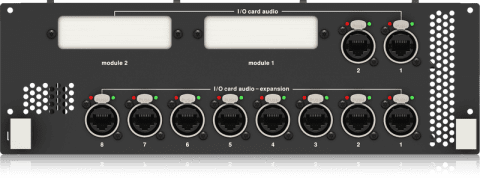
The NEUTRON-NB Network Bridge expansion module compatible with the MIDAS NEUTRON audio system engine provides a multichannel interface between two third party digital audio networks and point-to-point interfaces. The third party interfaces operate in separate clock domains and are connected by a bidirectional asynchronous sample rate converter (ASRC). This unique KLARK TEKNIK technology allows the interfacing of up to 64 bidirectional channels between the two independently clocked domains, which can also operate at different sample rates. Compatible with the KLARK TEKNIK KT-AES50, KT-DANTE64, KT-MADI and KT-USB network modules, NEUTRON-NB is future-proofed in the evolving world of digital audio networking technology by being able to support new and emerging protocols via its two industry-standard expansion slots, which are compatible with the Cirrus CM-1* format.
    I/O Interfaces
  • Dante Ch: 64x64
  • 16-bit, 24-bit, 32-bit
Dante官网logo
  • BARE

BARE – WCS-500M

Features: 1. The wireless conference system eliminates cumbersome wiring, is quick and easy to install, and is simple to operate. It is especially suitable for use in scenarios such as project transformation, mobile conferences, temporary equipment increase, and wiring failure. The system adopts digital and analog fusion design, can realize the camera tracking function, embedded DSP audio processing technology, 4-inch touch screen management and settings, easy to use and intuitive, cooperate with the AOIP network audio transmission module to achieve audio signal interconnection, and the module supports mainstream networks Audio transmission protocol. 2. The wireless radio frequency technology transmits audio and digital control signals, with high-fidelity sound quality, no compression, clear and transparent, and the wireless control signal is reliable and stable; 3. Support camera tracking function, can connect to the camera through RS485, RS232, etc., support VISCA, PELCO-D/P camera control protocol, and can independently connect a camera for camera tracking; 4. It has a video switch RS232 communication port, which can be connected to a high-definition video switcher or a high-definition matrix, and supports up to 8 cameras for camera linkage; 5. Built-in high-speed DSP processor, based on artificial intelligence self-learning algorithm developed adaptive feedback suppression (AFC) and automatic noise reduction technology (ANC), deep learning analysis of the feedback signal that causes howling, and quickly eliminate the cause of howling Repetitive signals, learning and analyzing environmental noise, background noise and current sound, etc., to remove useless noise 6. The host supports a variety of conference modes: such as first-in first-out, chairman priority mode, the number of open microphones supports 1-4, and the system can carry up to 128 microphones; 7. The directivity can be adjusted with the microphone, supporting 5 modes: omnidirectional, cardioid directivity, super cardioid directivity, sharp cardioid directivity, figure 8 directivity, etc.; 8. Extend AOIP network audio transmission to support mainstream. The refined and elegant 4-inch touch screen is used for conference host management and settings, and can display the following information at the same time: a. Speaking mode selection, speaking quantity limit function b. Radio frequency grouping and radio frequency signal strength display c. AFC adaptive feedback suppression is turned on and off, d. ANC automatic noise reduction on and off e. System volume adjustment f. System settings and status view, switch between Chinese and English 6. Network transmission protocol, realize audio signal interconnection and intercommunication
    I/O Interfaces