Lawo – mc²56


More details

Similar Products

Q225_Screen_Side_High_Res_Main0000 (1)|QRack_Dante_Back_Angle_0004
  • DiGiCo

DiGiCo – Quantum 225

Under The Hood

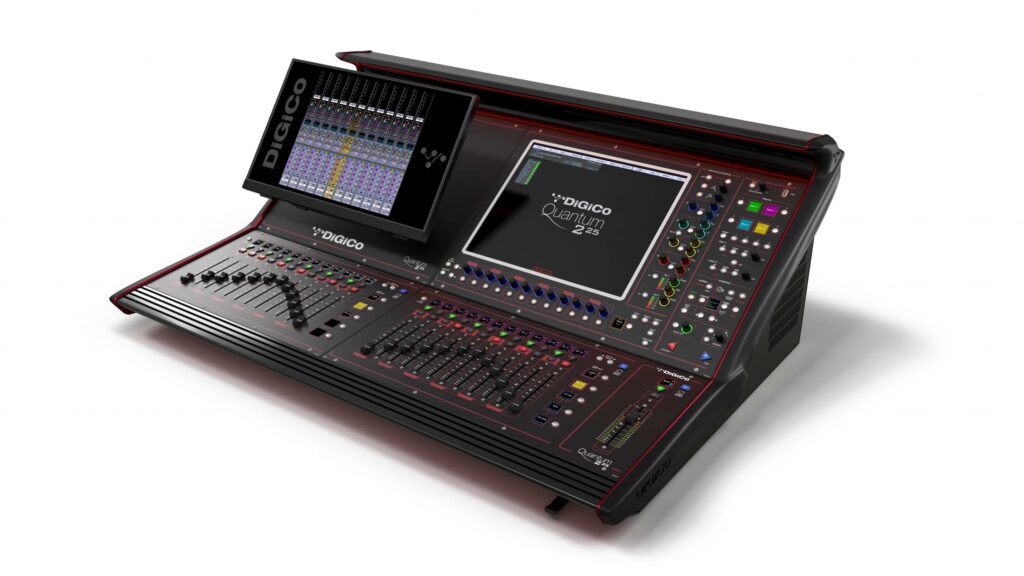
Quantum 225 brings a 17-inch, 1000 nit, high brightness multitouch screen with both a meter bridge and soft quick select buttons for quick and intuitive operation. 41 individual TFT LCDs displaying channel information and metering, bank information, macros and more guide you immediately to the controls you need. Plus, 25 100mm touch sensitive faders in two banks of 12 plus a dedicated user-assignable master fader with high resolution metering.

But there’s more… The defining feature of the Quantum 225 is the ability to customise the left worksurface with the Mounting Bracket. Mount a laptop for creative control, or a KLANG:kontroller for immersive control. You could even mount an extra screen to show your KLANG:app, plugin computer, console overview screen, or it could even display the channel screen for your left bank of faders, transforming your Quantum 225 into a dual screen console at an unbelievable price point!

With a maximum of 72 input channels with 36 busses and a 12 x 12 matrix, all with full channel processing, Quantum 225 brings Quantum to a wider user base. Also included as standard are Mustard Processing channel strips, Spice Rack plugin style native FPGA processing options, Nodal Processing and True Solo.

I/O

Despite being a smaller format console, there hasn’t been any sacrifice when it comes to connectivity.

Local I/O: Quantum 225’s local I/O includes 8 analogue inputs, 8 analogue outputs and 2 AES I/O (4 channels)

MADI: Quantum 225 offers 2 redundant MADI in/out at 48kHz, which can also be configured as 4 MADI I/O. At 96kHz this acts as 2 MADI I/O with full channel counts.

Optocore: The Quantum 225 offers the option to add a single or dual loops of Optocore. On each loop, which is 504 channels of audio; there can be up to 14 DiGiCo racks, or a combination of racks and tie-lines around the loop. With dual Optocore loops, that’s 1,008 Optocore channels of audio and 28 racks running.

UBMADI: In addition, the engine has a 48-channel UBMADI, so you can connect any laptop via USB and get 48 channels of recording and playback.

DMI: We have also incorporated two dedicated DMI slots to accommodate the growing family of DiGiCo DMI card options. Allowing the console connectivity to be configured for the demand of the tour or event, you could plug in a Dante module, or the latest automatic mic mixing module. Each dedicated DMI slot provides you with an additional 64 x 64 I/O.

Waves: There is also an option to add Waves connectivity if you want to utilise SoundGrid processing, giving you a 64 x 64 additional I/O.

    Mixers
  • Dante Ch: 64x64
  • 24-bit
Soundcraft_-_Vi_1|Soundcraft_-_Vi_1
  • Soundcraft

Soundcraft – Vi1

A complete standalone console package with 32 channels of analogue input to 27 analogue outputs, plus 6 digital inputs, 4 Stereo FX Returns and 6 digital outputs in one chassis. A complete standalone console package with 32 channels of analogue input to 27 analogue outputs, plus 6 digital inputs, 4 Stereo FX Returns and 6 digital outputs in one chassis. As standard, Input to mix capacity is 46chs, but by adding a stagebox (compatible with the existing Vi racks), simultaneous channel count increases to 64. Channels are routable to 24 multifunction busses, plus LR and Mono Mix busses. Up to 8 of the busses can be configured as Matrix mixes, each with up to 16 sources. The surface is just over a metre wide, and includes 16 motorised channel faders with fixed and user-definable layers, 8 output/VCA faders and 2 master faders. What's really cool about the Vi1 though, is the new Widescreen Vistonics interface, which will be instantly familiar to anyone who's driven a Vi6 or Vi4, as well as retaining the same 'walk-up' user-friendliness of the other Vi consoles. This new development displays all parameters for 16 channels side by side, on a single 22" Vistonics touch screen. The upper half of the screen handles the Output section control as well as Cue List or Menu displays. Parameter control is via two rows of 16 rotary encoders. Exactly the same channel functionality as the Vi6 and Vi4 is available here, along with all the same core snapshot, talkback and monitoring facilities. Naturally, the Vi1 inherits many of the facilities of its larger siblings, including Soundcraft FaderGlow™, 4 stereo Lexicon effects engines, BSS Audio graphic EQs on all output busses, and integral dynamics on all channels. The desk is also compatible with Vi2, 4 and 6 show files. As you’d expect, the price of the Vi1 is extremely attractive, which is sure to make it a clear winner with engineers and sound companies.
    Mixers
  • Dante Ch: 64x64
  • 24-bit
calrec-summa_1200px
  • Calrec

Calrec – Summa 128

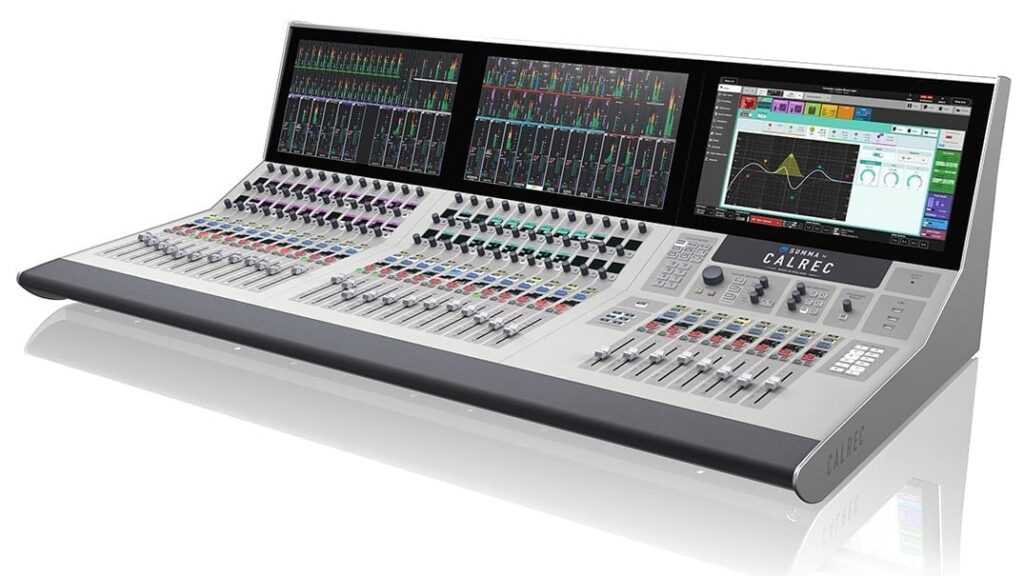
Calrec’s elegant Summa console is designed for broadcast professionals who need to produce creative and engrossing broadcast audio easily, but may not require as many resources as Calrec’s Apollo and Artemis consoles. Calrec’s elegant Summa console is designed for broadcast professionals who need to produce creative and engrossing broadcast audio easily, but may not require as many resources as Calrec’s Apollo and Artemis consoles. Control is via a 17-inch multitouch screen inspired by familiar tablet technology, with a straightforward interface that uses established finger gestures to navigate the system. Summa’s considered control simplifies even complex workflow tasks, such as creating mix-minus feeds. Bluefin2 technology gives the Summa 128 a pool of 128 channel processing paths, eight groups, four mains, 16 auxes, and 32 tracks. Its Hydra2 router core provides Summa with the same integral router technology as the Apollo and Artemis consoles.
    Mixers
  • Dante Ch: 64x64