Hugel – GPIO


More details

Similar Products

peai9090a
  • Profitt

Profitt – PEAI-9090

The devices are designed for:

- connection of analog or digital audio signals in AES 3 format to the local audio transmission network ( AoIP ) using AES 67, Dante protocol ;

- connection of microphones to the local audio transmission network ( AoIP ) via AES 67, Dante protocol ;

- audio data exchange between Ethernet Dante , AES 67 and 3 G / HD / SD SDI digital video signals (devices with index ' V '); - creation of a distributed network of audio switches with a common switching field; - transfers

Ethernet ( AES 67, Dante ) over optical links;

- indication of audio signal levels ( PEAI -9090, PEAI -9091).

Ethernet Dante audio interfaces , AES 67 support:

- 8 in, 8 out ( PEAI -9088, PEAI -9090) and 16 in, 16 out ( PEAI -9091) balanced analog audio

or 4 in, 4 out ( PEAI -9088, PEAI -9090) and 8 in, 8 out ( PEAI -9091) AES 3 digital audio channels .

Devices with suffix ' V ' contain a 4-channel audio communication module between Ethernet Dante , AES 67 and 3G / HD / SD SDI digital video signals . The devices have an SDI input and two SDI outputs . Up to 16 audio channels of SDI embedded audio are supported .

Devices with suffix ' R ' contain an AES 3 digital audio input/output module with support for User Bits and Channel Bits (compatible with Riedel intercom equipment ).

The PEAI -9090 and PEAI -9091 devices can be equipped with submodules with microphone inputs (suffix ' M ' in code). This provides a voltage supply of '+48 V ' to the microphones and control of the gain of signals from the microphones.

The front panel of the PEAI -9090 and PEAI -9091 has a display that shows indicators for input and output signals.

The type of audio signals for inputs and outputs, independently of each other, is selected by the User (should be reflected in the device code).

The devices have two electrical Ethernet 100/1000 BaseT ports - primary ( Primary ) and backup ( Secondary ) and one optical (except for PEAI -9091). A redundant electrical Ethernet port provides connection to a redundant audio transmission network or device cascading. The presence of an optical transmission line through a separate SFP module allows you to transmit Ethernet ( AES 67, Dante ) over optical communication lines over long distances

( Ethernet SFP module not included in the device; see section 'SFP modules optical and electrical', section II , pos. 1.1:1.6).

Management and monitoring are carried out over the Ethernet network using the proprietary Dante Controller program and via the WEB interface.

Separate power inputs for main and backup power supply. 'Hot' replacement of power supplies.

Audio connectors DB 25 and RJ 45 (on module ' R ').

    I/O Interfaces
dd-rn42
  • RDL

RDL – DD-RN42

The DD-RN42 is a complete wall-mounted Dante audio network interface. It features two XLR mic or line inputs on the front panels, two balanced line inputs on a rear-panel detachable terminal block and two balanced line outputs on front-panel XLR jacks. The module is configured and adjusted using RDL CONSOLE or other network control software. The DD-RN42 fits a standard US dual-gang electrical box or an RDL WB-2 back box for installations in thinner European or equivalent walls. The DD-RN42 is PoE powered, and is available in multiple finishes with optional customized graphics.

Mic/Line to network section

The two XLR inputs are each converted to a separate Dante network transmit channel. Three gain settings are software-selectable for both the mic and line input ranges to match condenser or dynamic mic levels and standard line levels. P48 phantom voltage may be software enabled when an input is set for mic level.

Line to network section

The two rear-panel balanced or unbalanced inputs are each converted to a separate Dante network transmit channel. Control software sets the gain for an input level of either +4 dBu or -10 dBV. RDL Decora®-style jack plates matching the appearance of the DD-RN42 are optionally available for connection of various audio sources to the rear-panel inputs. An input plate may be located together with the DD-RN42 in a triple gang box or may be mounted remotely in a single box.

Network to line section

Two Dante audio channels are converted to balanced line level feeding front-panel XLR jacks. Each output provides +4 dBu balanced for a network digital audio level of -18 dBFS. Each output is equipped with a software controlled attenuator adjustable in 1 dB steps to a maximum attenuation of 62 dB then OFF. The outputs are connected through a detachable terminal block.

Valid PoE power and synchronization to the Dante network are indicated by green LEDs visible from the front of the unit.

The DD-RN42 is a professional grade product with RDL mic preamplifiers for studio quality fidelity and low noise performance, coupled through XLR jacks housed in a steel chassis with dual powder-coated or stainless steel Decora front plates.

The DD-RN42’s superior performance specifications make it ideally suited to installations requiring network control and exceptional value in commercial networked audio systems. This full-featured product is engineered and manufactured in the U.S.A for continuous duty in demanding installations. Designed to outperform. Built to last.

    I/O Interfaces
  • Dante Ch: 2x4
  • 24-bit
  • Aavaro

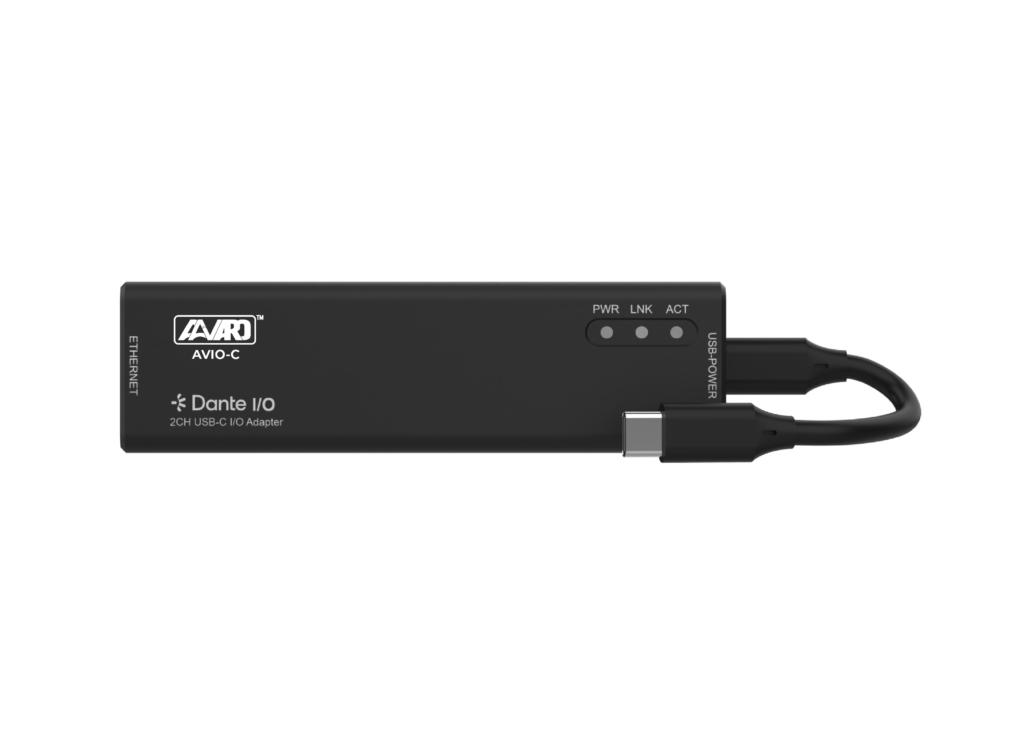
AAVARO™ 2IO-C

AAVARO™️ 2IO-C is a compact 2-channel USB-C audio interface designed to provide simple and reliable bidirectional audio connectivity between compatible USB host devices and Dante audio networks. Recognized as a standard USB audio device, 2IO-C supports simultaneous two-channel audio input and output without requiring additional drivers or software. It provides a convenient Dante audio access point for laptops, workstations and other compatible USB host devices. Designed for professional AV, conferencing, presentation, recording and installed audio environments, 2IO-C combines plug-and-play operation with flexible deployment. It supports Windows, macOS, Linux and Android platforms, sample rates of 48 kHz, and selectable Dante latency settings of 1, 2 and 5 ms.
    I/O Interfaces
  • Dante Ch: 2x2
  • 16-bit, 24-bit, 32-bit