
Alcorn McBride – V-Com VC32K


More details

Similar Products

ru-nl2p_400px
  • RDL

RDL – RU-NL2P

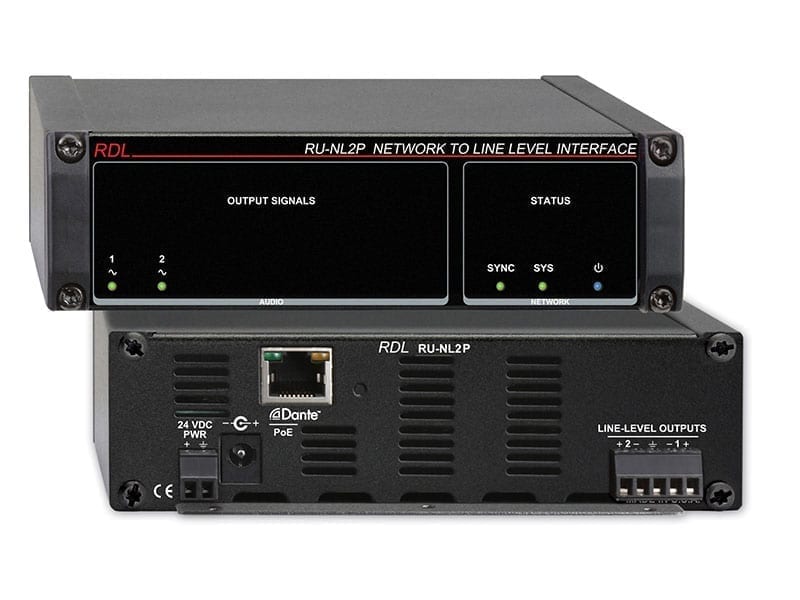
The RU-NL2 is a high quality Dante network to line level interface. The RU-NL2 converts two Dante network audio channels to +4 dBu balanced line level that corresponds to a network digital audio level of -18 dBFS. LED audio signal indicators are provided. Model RU- NL2P operates from PoE. The RU-NL2 is a high quality Dante network to line level interface. The RU-NL2 converts two Dante network audio channels to +4 dBu balanced professional line level. The front panel features signal LEDs that indicate audio presence for each of the received network signal channels. Balanced +4 dBu audio levels correspond to a network digital audio level of -18 dBFS. The noise floor is better than 80 dB below operating level. Crosstalk is below the noise floor between the outputs across the entire audio spectrum. The RU-NL2 is also available in a PoE version (RU-NL2P). If PoE power and an external 24 Vdc supply are both feeding an RU-NL2P, the unit will run from the external supply and will seamlessly switch over to PoE power upon loss of the external supply. 
    I/O Interfaces
ssl-io-hc-bridge-src
  • Solid State Logic

SSL – HC bridge SRC

The HC Bridge SRC provides 256 bi-directional channels of sample rate conversion for AoIP networks. HC bridge SRC facilitates connecting audio between devices running at different sample rates or in different clock domains on a Dante (48khz and 96khz), AES67 or ST 2110-30 networks. The two network connections can be physically or virtually separate networks, providing control isolation between two sets of equipment where an “AoIP discovery and control firewall” is required. A HC bridge SRC includes 2 HC cards, each HC card provides 512 Tx and 512 Rx channels at 48khz, 256 Tx and 256 Rx at 96khz, with 128 Tx and 128 Rx streams at all sample rates. Each card includes redundant pair SFP cages for RJ45 or fibre Dante/AoIP connectivity.

    I/O Interfaces
  • Dante Ch: 256x256
  • 24-bit
yamaha-swr2100p_10g_1200px|yamaha-swr2100p_10g_1200px
  • Yamaha

Yamaha – SWR2100P-10G

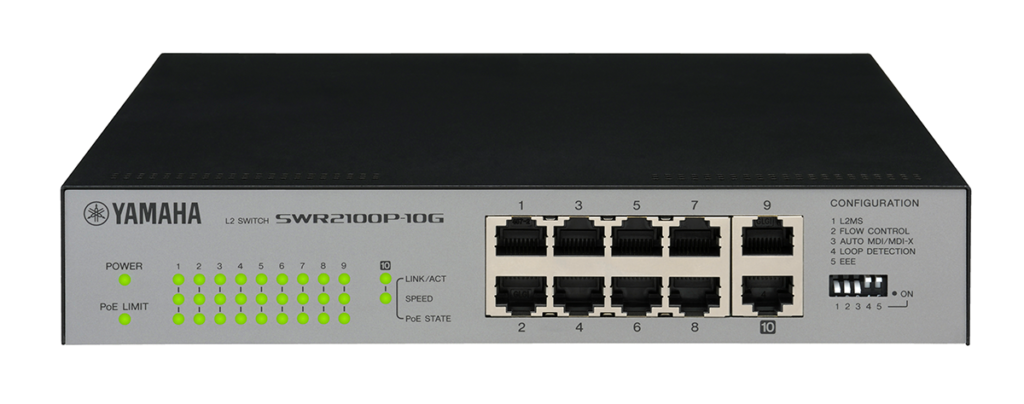
Complex network switch setup that was previously better left to an IT technician can now be easily accomplished by anyone. A simple switch setting is all it takes to optimize SWP1 series network switches for Dante operation, and a dedicated Windows application provides “network visibility” for comprehensive monitoring and control. Yamaha has used its knowledge of both IT and pro audio to provide "SWR2100P series" simple L2 switch that has been optimized for networked audio installations. The switch can take advantage of "Yamaha LAN Monitor" a dedicated Windows application that provides 'network visibility' for comprehensive monitoring and control. The "SWR2100P series” which are simple L2 switches can supply power as well as audio and control signals to a PoE-compliant Dante device such as the paging station microphone “PGM1” through just one Ethernet cable. Since the power supply and the network wiring can be combined, the number of cables being used can be reduced, and the connection distance can be extended, so the degree of freedom of Dante device installation is increased and construction flexibility is further improved. Systems built around the SWR2100P-5G or SWR2100P-10G L2 switches allow comprehensive network monitoring from the dedicated Yamaha LAN Monitor software application, with PoE power status monitoring and ON/OFF switching capability. Understanding how multiple switches installed in different locations are connected, plus how network devices are connected to those switches, can be a difficult, time-consuming task. The Yamaha LAN Monitor makes overall network topology clearly visible, giving the user a comprehensive overview of how multiple switches and Dante network devices are interconnected. Simply connect a Windows PC to the nearest SWR2100P series switch and launch the Yamaha LAN Monitor software. You can take a “snapshot” of the network status when set up as required. The software can then automatically keep track of the settings and alert you to any changes. You could take a snapshot of the network, and then you would be alerted if a cable is disconnected, if a device is turned off, or if a wrong connection is made prior to the performance, for example. Identifying devices connected to a switch by only their IP or MAC address is a difficult and error-prone approach. Connected Dante devices are identified by a Dante icon as well as a device ID previously set up via the Dante Controller software. You can also enter additional info, such as the location of the device, in the Label and Comment fields. If the monitoring device does not respond to a Ping, it judges that a fault has occurred and automatically stops the PoE power supply to that device and then resumes it. This restarts the monitoring equipment and attempts recovery. By collectively managing the status of the devices distributed over a wide area, it can ensure that equipment management can operate far more smoothly.
    I/O Interfaces