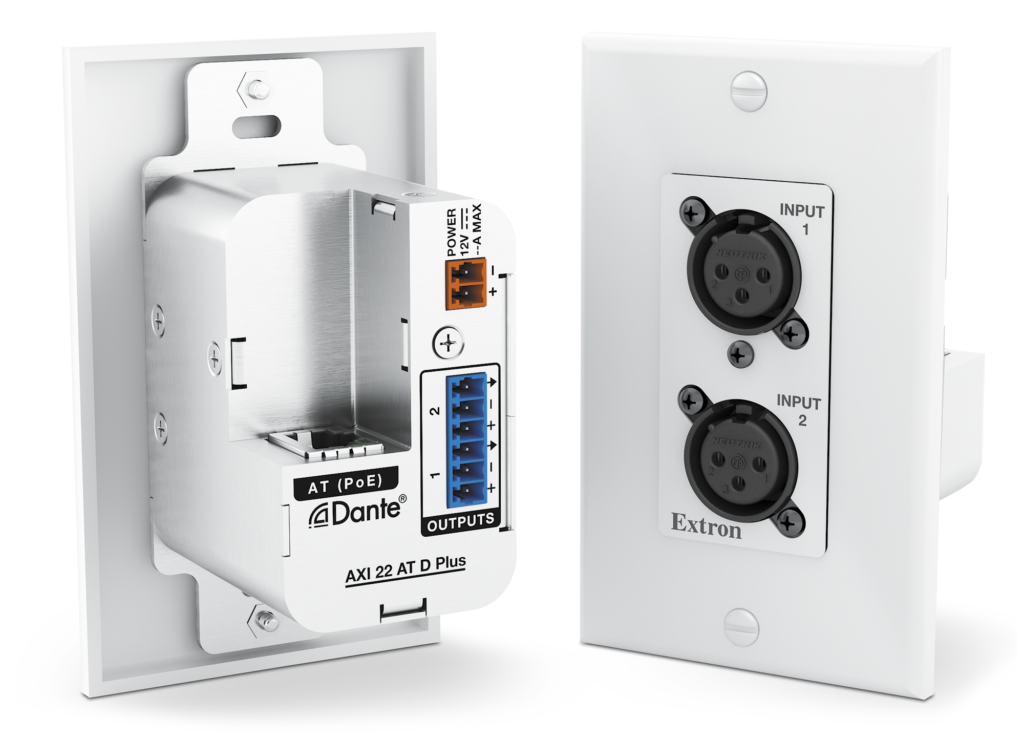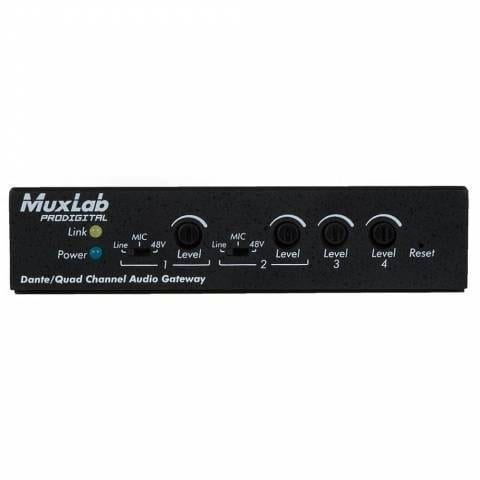

Micromedia – DIO RCA TOS PoE


More details

Similar Products

yamaha-swr2100p_10g_1200px|yamaha-swr2100p_10g_1200px
  • Yamaha

Yamaha – SWR2100P-10G

Complex network switch setup that was previously better left to an IT technician can now be easily accomplished by anyone. A simple switch setting is all it takes to optimize SWP1 series network switches for Dante operation, and a dedicated Windows application provides “network visibility” for comprehensive monitoring and control. Yamaha has used its knowledge of both IT and pro audio to provide "SWR2100P series" simple L2 switch that has been optimized for networked audio installations. The switch can take advantage of "Yamaha LAN Monitor" a dedicated Windows application that provides 'network visibility' for comprehensive monitoring and control. The "SWR2100P series” which are simple L2 switches can supply power as well as audio and control signals to a PoE-compliant Dante device such as the paging station microphone “PGM1” through just one Ethernet cable. Since the power supply and the network wiring can be combined, the number of cables being used can be reduced, and the connection distance can be extended, so the degree of freedom of Dante device installation is increased and construction flexibility is further improved. Systems built around the SWR2100P-5G or SWR2100P-10G L2 switches allow comprehensive network monitoring from the dedicated Yamaha LAN Monitor software application, with PoE power status monitoring and ON/OFF switching capability. Understanding how multiple switches installed in different locations are connected, plus how network devices are connected to those switches, can be a difficult, time-consuming task. The Yamaha LAN Monitor makes overall network topology clearly visible, giving the user a comprehensive overview of how multiple switches and Dante network devices are interconnected. Simply connect a Windows PC to the nearest SWR2100P series switch and launch the Yamaha LAN Monitor software. You can take a “snapshot” of the network status when set up as required. The software can then automatically keep track of the settings and alert you to any changes. You could take a snapshot of the network, and then you would be alerted if a cable is disconnected, if a device is turned off, or if a wrong connection is made prior to the performance, for example. Identifying devices connected to a switch by only their IP or MAC address is a difficult and error-prone approach. Connected Dante devices are identified by a Dante icon as well as a device ID previously set up via the Dante Controller software. You can also enter additional info, such as the location of the device, in the Label and Comment fields. If the monitoring device does not respond to a Ping, it judges that a fault has occurred and automatically stops the PoE power supply to that device and then resumes it. This restarts the monitoring equipment and attempts recovery. By collectively managing the status of the devices distributed over a wide area, it can ensure that equipment management can operate far more smoothly.
    I/O Interfaces
digigram-AUDIOWAY-bridge-B3_1200px|digigram-AUDIOWAY-bridge-B3_1200px
  • Digigram

Digigram – AUDIOWAY Bridge B1

The AUDIOWAY Bridge B1 is an intelligent gateway between MADI and AES/EBU digital audio streams and AES67/Dante™ synchronous audio-over-IP streams. The AUDIOWAY Bridge B1 is an intelligent gateway between MADI and AES/EBU digital audio streams and AES67/Dante™ synchronous audio-over-IP streams. Forming the backbone of your infrastructure, the AUDIOWAY Bridge B1 is the ideal solution to distribute and interconnect your audio streams both in the studio and externally. Thanks to the software supplied with the product, the BRIDGE B1 can be used to route as well as monitor all inputs/outputs in every format (MADI – AES/EBU – AES67/Dante™). As a complete single-box system  it not only bridges audio-over-IP (AoIP) streams and legacy signals, but also ensures clock synchronization between the two systems. AUDIOWAY Bridge B1 allows you to route and monitor low latency audio whatever the technology/protocol. It brings a seamless studio management with AVS-monitor, Dante™ Controller and multiple presets. It reduces the cost and complexity of AoIP integration into your studio infrastructure. The AUDIOWAY Bridge B1 features 64/64 Dante™/AES67 full-duplex I/O channels, and is equipped with both 64/64 MADI I/O and 16/16 AES/EBU I/O digital audio interfaces, as well as a low latency hardware routing matrix between all inputs and all outputs.. AUDIOWAY Bridge B1 is very simple to use thanks to its control application which provides complete configuration and monitoring of all the streams operated by the equipment.  


    I/O Interfaces
DCS-101主机
  • BARE

BARE – DCS-101DMX

1. Original D-net IOT digital conference IoT system technology, in line with IEC60914 international standard 2. Support 41kHz/48kHz audio sampling rate, long-distance transmission will not have any impact on sound quality 3. The host computer and the computer can be connected through TC/IP or network access WiFi to realize wireless control mode, and the host can realize IP-based address allocation to realize distributed application management 4. D-net IOT technology can realize the flexible completion of networking or independent partitioning of multiple conference systems, and a variety of conference fields can be used for expansion 5. Dante network audio interface, support to match any Dante audio equipment, and realize computer host computer software control and I Pad software remote control to set various parameter values through the use of TCP/IP connection; 6. Support Ethernet (POE) power supply, digital signal, DSP control, one cable digital link system unit adopts loop loop connection (1 output, 1 backup input) to ensure the efficient and normal use of the system. 7. The system supports line "hot plugging", and microphones can be added to the system at any time 8. With the camera tracking host, after using the computer preset, the camera can automatically track and support the preset panoramic position 9. The self-developed technology of D-net IOT digital conference IOT system realizes five adjustable modes of directional microphones: omnidirectional, cardioid directional, super-cardioid directional, sharp-heart directional, Figure- 8-pointing type; 10. The system host supports dual-backup output of analog and digital signals, and supports dual-backup power supply for POE power supply and external 24V module; 11. Optional external 4-inch wall control touch screen for conference host management and settings, which is convenient and efficient, and can display the following information at the same time: a. Time-limited mode: The speech time limit can be set to 1-60 minutes, and the speech will be automatically closed when the time is up. After reaching the power-on quantity, when another representative unit wants to speak, it will automatically enter the request-to-speak registration queue. b. First-in-first-out mode: First-in-first-out speaking mode (factory preset position), after reaching the number of power-on, the speaking unit opened first is closed by the subsequent speaking unit. c. Application for speaking mode: the speaking of the representative unit needs to be approved by the chairman unit or the operator. In this mode, the chairman unit always keeps the normally open state. d. First-in-first-out mode; you can choose 1/2/4/6 microphones to speak at the same time, and the chairman microphone and VIP microphone can be preset without restriction. e. Volume adjustment of main output 12. The system can be connected to PC control to achieve centralized microphone management. Through software, microphone pickup gain adjustment, forced switching, speaker information registration, can initiate sign-in function, detect microphone line conditions, software set VIP unit, VIP unit The switch is not limited by the number of conference units that are open at the same time and the speaking mode 13. Network-based collaborative management, the system host can set the IP address, and use advanced TCP/IP network connection between the control PC and the host, such as the network access WIFI, which can realize the wireless control and management of the PC and the host, and realize the distributed Application and management. 14. Input and output interface: 4-channel balanced microphoneline input, using phoenix plug interface; 4-channel balanced audio output, using Phoenix plug interface; 4-channel network DANTE audio input, using RJ45 network interface; 4-channel network DANTE audio output, using RJ45 network interface; Support up to 48K/96K, 24BIT uncompressed CD-level sound quality; 15. Provide two wireless UHF ultra-high frequency handheld microphones for auxiliary pickup. 16. Built-in feedback suppressor, noise cancellation, echo cancellation and other main algorithms; 17. A variety of control methods, which can be managed by computer, central control, touch panel, etc.; 18. Provide 6 100/1000M adaptive RJ45 ports, single port maximum power 60W, automatic detection and identification of standard PoE power receiving equipment; 19. Provide 1 100/1000M adaptive RJ45 port as uplink port; 20. Provide 1 Gigabit SFP optical fiber module expansion slot; 21. With a variety of audio processing functions such as; 31-band equalizer, 13-parameter equalizer, compressor, limiter, expander, crossover, crossover, mixer, filter, noise gate, dumb Sounder, automatic gain, signal indicator and signal generator, etc.; 22. Multiple conference hosts can be used as independent conference systems, or can be easily expanded to form a large-scale conference system to achieve flexible configuration of multiple conference rooms 23. Dante interface, transmit audio signals through the network, low delay, high efficiency, realize real-time audio interconnection in large conferences or multiple conference rooms, and support mainstream network audio protocols
    I/O Interfaces